
Employee Walking Distance and Time Calculation
A walking limit looks like a single number, but behind it sit the vehicle count, trip duration and whether employees will use the shuttle at all. 300 meters on the flat is not the same walk as 300 meters uphill.
Definition
What is employee walking distance and time calculation?
Employee walking distance and time calculation is a planning solution that measures the walk between each employee's address and their shuttle stop. It is used by shuttle planning teams who decide stop placement and set the walking limit.
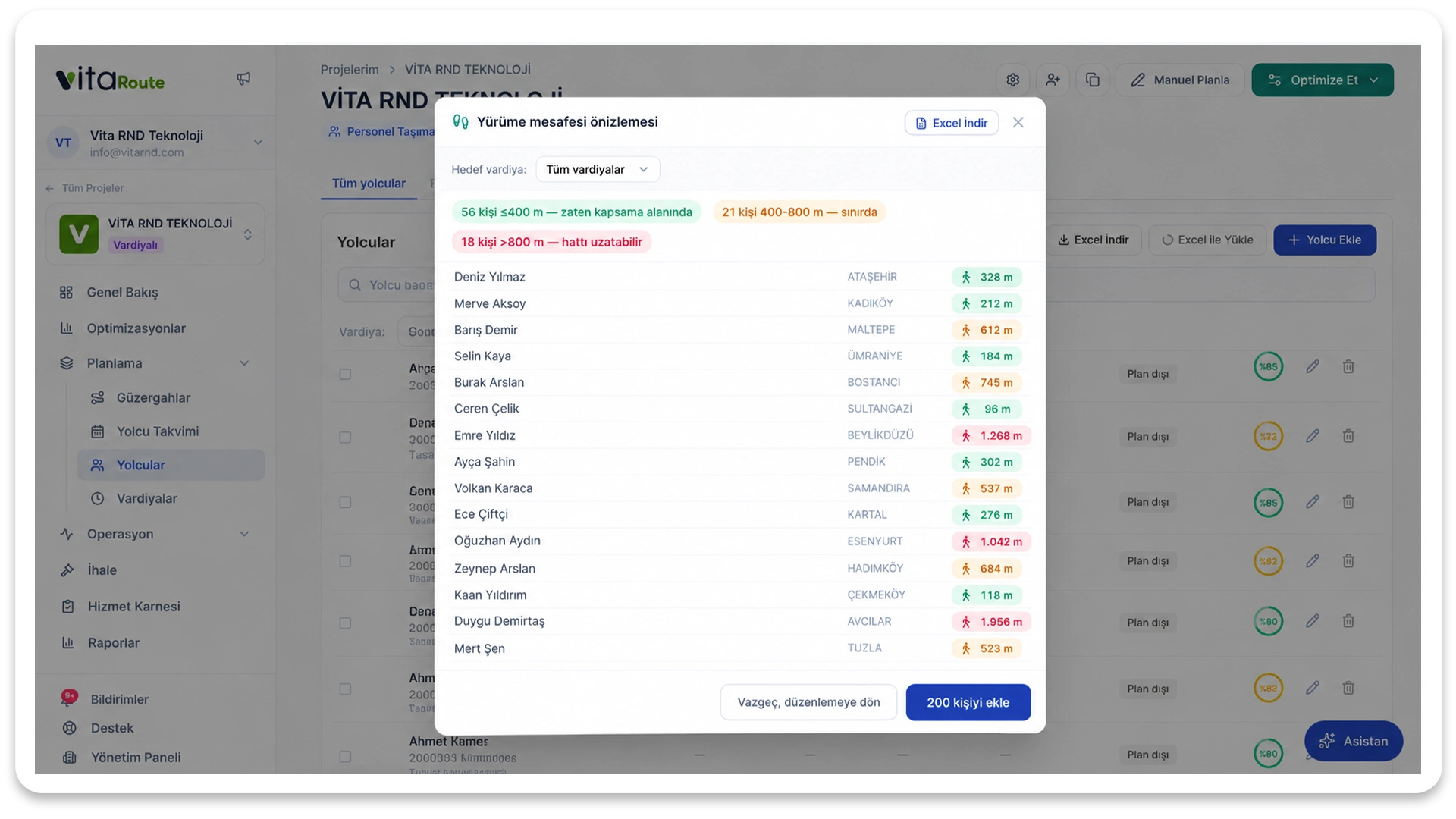
The calculation follows the real pedestrian path, not a straight line, and accounts for slope. In vitaRoute the limit can be defined per zone; employees who exceed it are listed, and before a stop is moved you can see which employees will be affected.
The problem
If the walking limit is wrong, the shuttle runs empty
Widening the walking limit reduces the number of stops, shortens the trip and often saves a vehicle. But once the limit exceeds the distance employees are really willing to walk, they stop using the shuttle.
This loss is invisible on the plan. Employees do not complain; they just stop boarding, and the price is paid as a falling occupancy rate.
Looking only at meters is a common mistake. On a sloped route, 300 meters is a much longer walk than on a flat one; in winter and in rain the gap widens. A manual straight-line measurement does not show this.
The solution
Walking measured on the real path and slope
vitaRoute calculates the distance and time between each employee's address and their assigned stop.
The calculation follows the real pedestrian path, not a straight line, and slope is factored in. The limit can be defined per zone: 200 meters may suit a hilly neighborhood and 400 meters a flat one.
As a result, employees who exceed the limit are listed, and before moving a stop you can see which employees will be affected. The decision is made in advance, not after the complaints.
What does it cover?
Walking Distance and Time Calculation
Distance and time on the real pedestrian path
Slope-aware calculation
A different walking limit per zone
A list of employees who exceed the limit
Affected employees shown when a stop is moved
Frequently asked questions
No. The calculation follows the real pedestrian path and accounts for slope. Both distance and walking time are calculated separately for each employee.
Explore
Other solutions
See your first plan for Walking Distance and Time Calculation in minutes
Upload your employee list, define your stops and shift times, and see your first plan in minutes.